Dexicon is not a company or a website. It's an open protocol: software anyone can run to trade MINIMA and MxUSD directly with everyone else who runs it, powered by the Minima network. Pure peer to peer: zero fees, no middlemen, and no one taking a commission on your trades.
That book is real and it's live. This page has no server of its own: your browser reads the fast orders straight from the network, just as every Dexicon client does. Inside a client, pool liquidity fills in the rest of the ladder.
Every row is a person.
Each order was placed by someone's own Minima node and is backed by coins in their wallet. Nobody holds them in between.
Every row is signed.
Orders carry the maker's signature. Your browser checked each one just now. Whoever passes an order along can't change it.
Every trade is final in one block.
Take an order and both sides sign a single Minima transaction. It settles on chain, wallet to wallet.
Three protocols. Together, Dexicon.
Dexicon joins three open protocols on Minima: cross-chain swaps to bring dollars in, liquidity pools anyone can earn from, and an exchange where the two meet. The Dexicon client for Android speaks all three. Anyone is free to build another.
1. MxUSD
Bring dollars in. The AtomiX atomic-swap protocol: swap USDT on Ethereum for MxUSD or MINIMA, peer to peer, across two chains.
Atomic swaps with hash time-locked contracts. Either both sides pay, or both are refunded.
USDT to MxUSD, or USDT to MINIMA, one market at a time.
Make a market, or trade OTC with a known counterparty.
A built-in Ethereum wallet derived from your node.
Add liquidity and earn, or swap. The PandaPools protocol: anyone can put MINIMA and MxUSD into their own pool and earn 0.5% on every swap that passes through it.
Your liquidity stays in your own pool, at your address. Add more or withdraw any time.
Swap straight against the pools, routed across all of them.
A verified backup is required before a pool goes live.
Recovery from the chain's archive if a device is lost.
One activity listEvery swap, pool action and trade in one ledger, with CSV export.
One assets pageMINIMA, MxUSD and your Ethereum USDT side by side.
Phone, tablet or foldOne column on a phone; two pages side by side on a tablet or an opened fold.
One client per walletAlready running AtomiX or PandaPools on their own? They hand over to Dexicon safely.
1. AtomiX: dollars in, across chains.
AtomiX swaps USDT on Ethereum for MxUSD or MINIMA on Minima, directly with another person. No bridge, no exchange and no wrapped token in between: each side's coins wait in a time-locked contract on its own chain until both sides can be paid.
One secret, two chains.
Both locks open with the same secret. The moment it's used to claim on one chain, it's public, and the other side can claim with it on the other.
All or nothing.
Each lock has a deadline. If anyone stops halfway, the deadlines pass and every coin goes back to where it came from. Nobody can end up with both sides.
Makers, not middlemen.
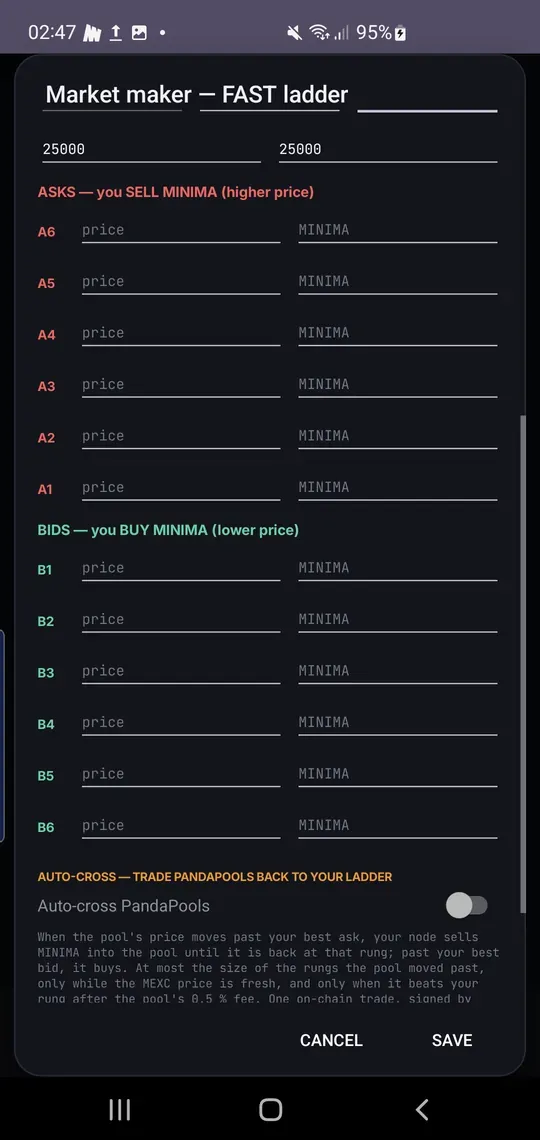
Anyone can make a market: publish a price for USDT to MxUSD or USDT to MINIMA, and your node completes the swaps it accepts on its own. Or agree a trade privately, over the counter.
Pick a price.Choose a maker's offer, or agree one privately.
Lock with a secret.The side that starts the swap creates a secret and locks first, against its fingerprint.
The other side locks.The counterparty locks on the other chain against the same fingerprint, with an earlier deadline.
Claim.The starter claims the counterparty's coins, which reveals the secret.
Claim back.The counterparty uses the revealed secret to claim the starter's coins. Done.
Your Ethereum wallet comes with your node. The client derives it from your Minima node, so there is nothing extra to set up. Only the Ethereum side pays gas, to Ethereum.
2. PandaPools: a pool of pools.
If you know Uniswap, you know the idea: add liquidity to a pool, and earn a share of every swap it makes. PandaPools does it on Minima's UTXO chain, where every pool belongs to the person who funded it, and the 0.5% goes straight to them.
Your pool is two coins.
A pool is a MINIMA coin and an MxUSD coin, locked under a contract that only lets them trade along the curve. They stay at your address, under your key. There is no shared vault holding everyone's money.
Every pool, one swap.
Every pool is owned by one person. A swap is split across all of them at once, best price first, in a single transaction that either completes fully or not at all.
Add liquidity. Earn 0.5%.
Put MINIMA and MxUSD into your own pool and every swap through it pays you 0.5%. The yield accrues inside your pool, so it grows as people trade. No LP tokens, no protocol cut, and you can add more or take it all back whenever you choose.
Uniswap
PandaPools
Where the money sits
One shared contract per pair, holding every provider's deposit
Your own pool, at your own address, under your own key
Providing liquidity
Deposit into the shared pool, receive LP tokens
Fund your own pool, keep the coins at your address
What liquidity earns
A share of the pool's swap fees, through your LP tokens
0.5% of every swap through your pool, paid to you, with no cut taken
How a swap is filled
Against the pair's shared pool
Split across every individual pool, peer to peer, in one atomic transaction
What a swap costs to settle
Ethereum gas, every time
Nothing. Minima has no transaction fees
Who runs it
Ethereum validators, reached through websites and providers
The users' own Minima nodes
The chain underneath
Account-based smart contracts
UTXO coins, each carrying its own contract
Start earning in the Pools room: create a pool, choose how much MINIMA and MxUSD to add, and back it up. Your node keeps the pool online, and every swap through it pays you directly. Add more or withdraw at any time.
3. The exchange: always a market.
Off-chain where speed matters, on-chain where trust matters. Fast limit orders move peer to peer in milliseconds, every pool adds its liquidity to the same ladder, and money only ever moves on chain.
Fast limit orders.
Signed off chain, shared across the network instantly, and settled wallet to wallet in one Minima block. Placing or cancelling an order costs nothing.
Never an empty book.
Every pool is quoted as orders at every price along its curve. As long as a single pool exists, there is always something to trade against.
One ladder, best price.
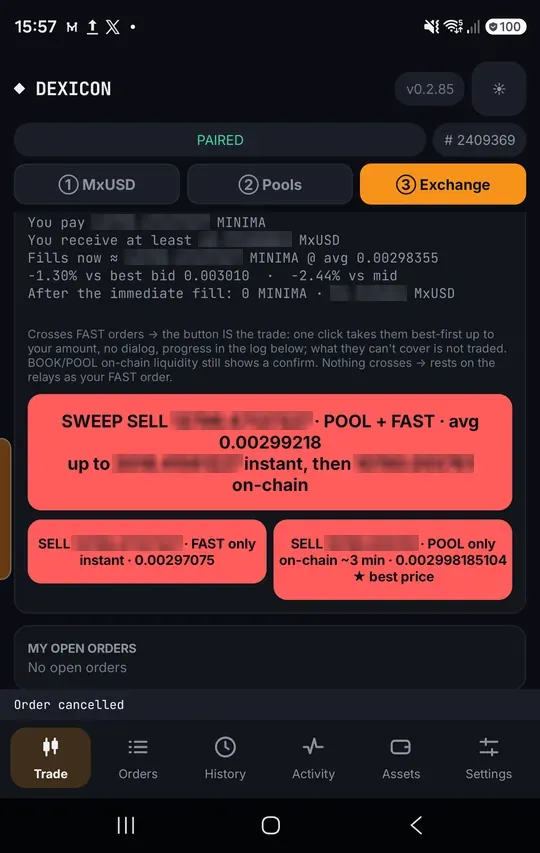
Fast orders, on-chain orders and pool liquidity sit side by side, each level showing where its depth comes from. A take fills from whichever source is best.
One fast trade, start to finish.
1Sign
2Share
3Take
4Co-sign
5Settle
Money moves once, in step 5, and the trade is final after one Minima block.
1. You sign an order.
Pick a price and an amount. Your client writes an order and signs it with a trading key kept on your device, separate from your wallet's keys. The order names the exact coins in your wallet that back it.
Nothing leaves your wallet. An order is a promise, not a deposit.
A real order, live from the networkwaiting for one…
The book is quiet right now. When an order arrives, its signed text appears here.
2. The network shares it.
Your order spreads across a federated network of nodes, powered by Minima and Maxima and run by the people who use them. Each node checks the signature and passes the order on unchanged. Orders and sealed messages travel this way; funds never do.
Anyone running a Parlons node takes part. No single node is special, and nodes can come and go while trading carries on.
3. Someone takes it.
A buyer takes your order. Their client builds one Minima transaction: their coins to you, your coins to them. They sign their half and send it to you in a sealed message only your node can open.
One transaction, two sidesillustration
Goes inBuyer's MxUSD coins Your MINIMA coins
Comes outMxUSD to your address MINIMA to the buyer
4. Your node co-signs.
Your client checks the transaction against your order: right price, right amount, nothing else touched. Then it adds your signature. It runs in the background, even with the screen off.
What your node checks before it signs
It pays your address at least price × amount, in the right token
It spends only the coins that back your order
No other output or state touches your wallet
All true, so your node adds its signature. Any false, and it refuses.
5. The chain settles it.
The finished transaction goes to the Minima network and settles in one block. Your order republishes with whatever is left.
Alongside the fast orders, the same ladder carries liquidity that lives entirely on chain: resting on-chain orders and every PandaPools pool.
FAST · peer to peerBOOK · on chainPOOL · liquidity pools
The first of its kind.
Cross-chain swaps, pools anyone can earn from, and a fast order book, joined into one exchange that nobody runs. Dexicon is truly peer to peer, from the first dollar in to the last trade out.
Decentralized
No company, no server, no single point of control. The protocol runs on its users' own nodes, and keeps running as long as anyone does.
Trustless
You never have to trust the person on the other side. Contracts and signatures make sure both sides are paid, or neither is. Every step can be checked.
Permissionless
No account, no sign-up, no approval. Anyone can trade, make a market, add liquidity, run a node or build a client from the open specification.
Global
Open to anyone, anywhere, with an Android phone or tablet and an internet connection. No borders, no region locks, no gatekeepers.
0
Zero fees to any middleman. The protocol, the network and the order book charge nothing, and no third party takes a cut of any trade.
The Dexicon protocolPlacing, cancelling and taking orders. Nobody collects a fee.
0
The Minima networkMinima has no transaction fees, so settlement is free.
0
Middlemen and commissionsThere aren't any. No operator, no broker, no platform cut.
0
Swapping against a liquidity poolPaid straight to the pool's liquidity providers as DeFi yield. Their liquidity makes the market, and every pool swap pays them for it. Nothing leaks to any third party.
0.5%to LPs
The Ethereum side of a swapMoving USDT on Ethereum pays Ethereum's own gas, to Ethereum.
gas
Anyone can earn the 0.5%. Add liquidity to a pool and every swap through it pays you directly. Supporting the market is the only way anyone earns from Dexicon, and it's open to every user. How PandaPools works
Powered by Minima.
A protocol can only be run by its users if the network underneath can be too. Minima is a blockchain designed so that every participant runs a complete node, even on a phone or tablet.
Every user is a full node.
Your device validates the chain itself. No servers to trust for your balance.
Zero transaction fees.
Moving coins costs nothing, so a trade costs nothing to settle.
Quantum-resistant signatures.
Minima signs with hash-based one-time keys, built for the long term.
Smart contracts on every coin.
Pools, on-chain orders and swaps are scripts on coins, readable by anyone.
MxUSD, the Minima dollar.
A dollar token on Minima. The MxUSD room trades it against USDT on Ethereum.
There is no Dexicon server. Orders travel between the nodes of the people using the protocol, over Minima and its Maxima messaging layer, and every trade settles on the Minima chain.
Anyone running a Parlons node takes part in carrying the network. No single node is required, and no one owns it.
How to, step by step.
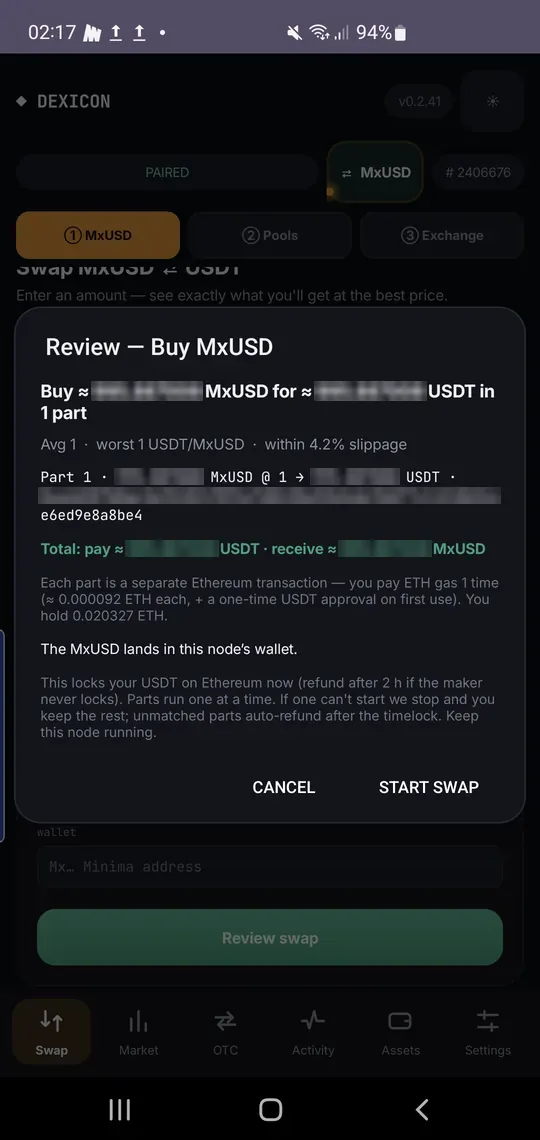
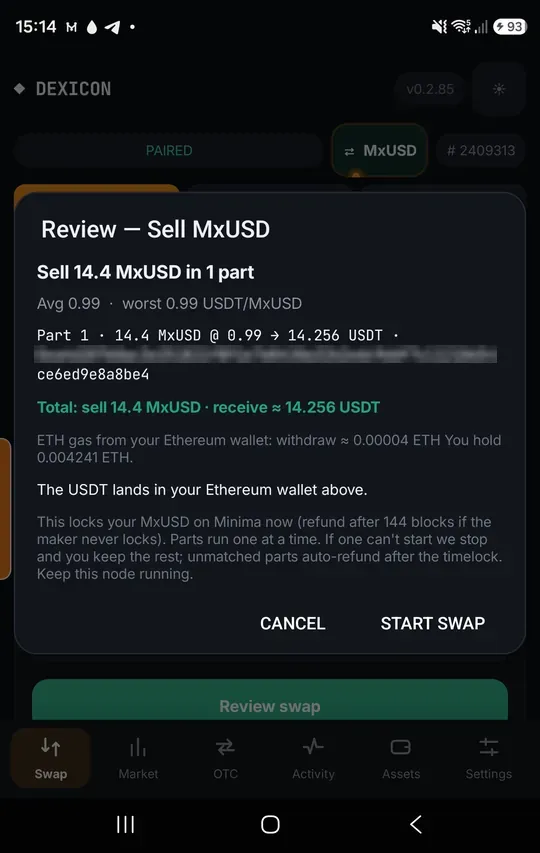
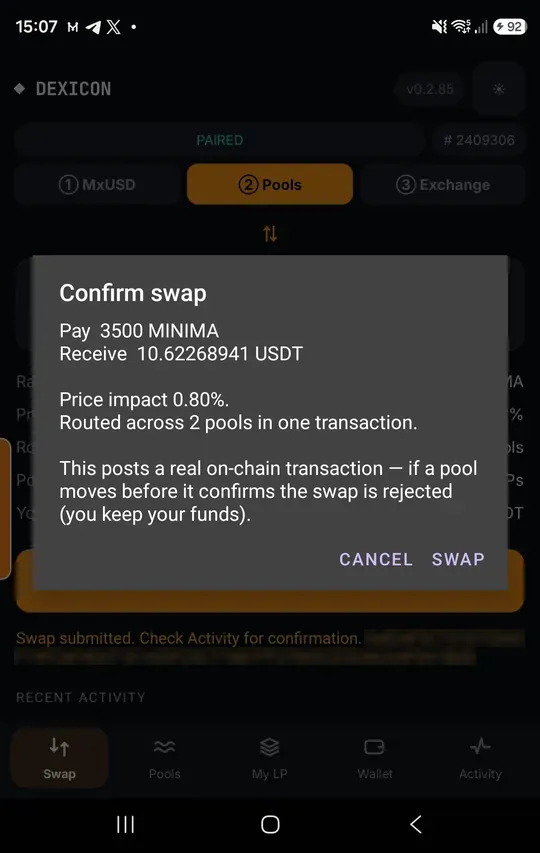
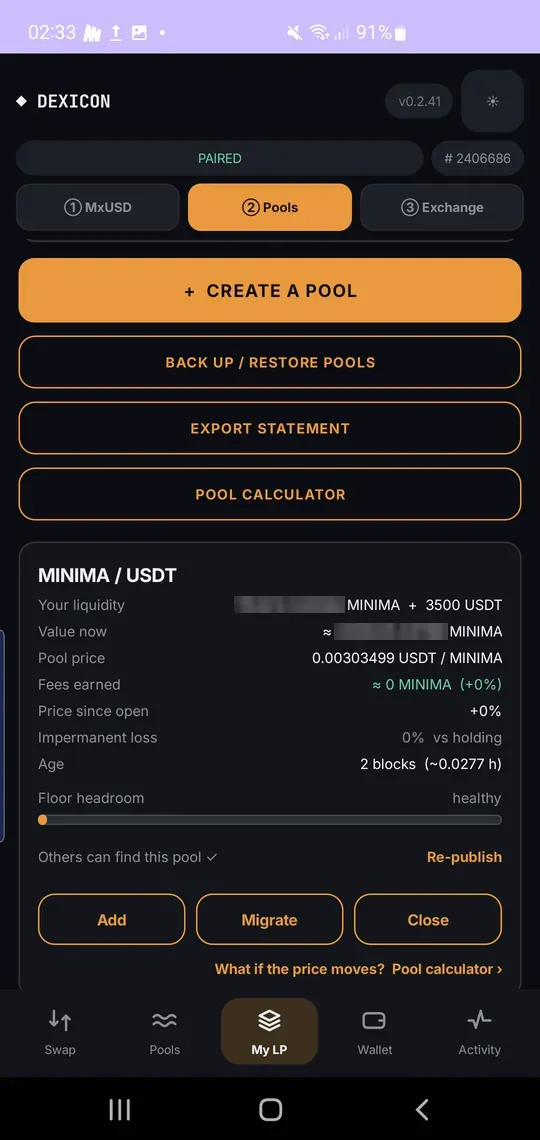
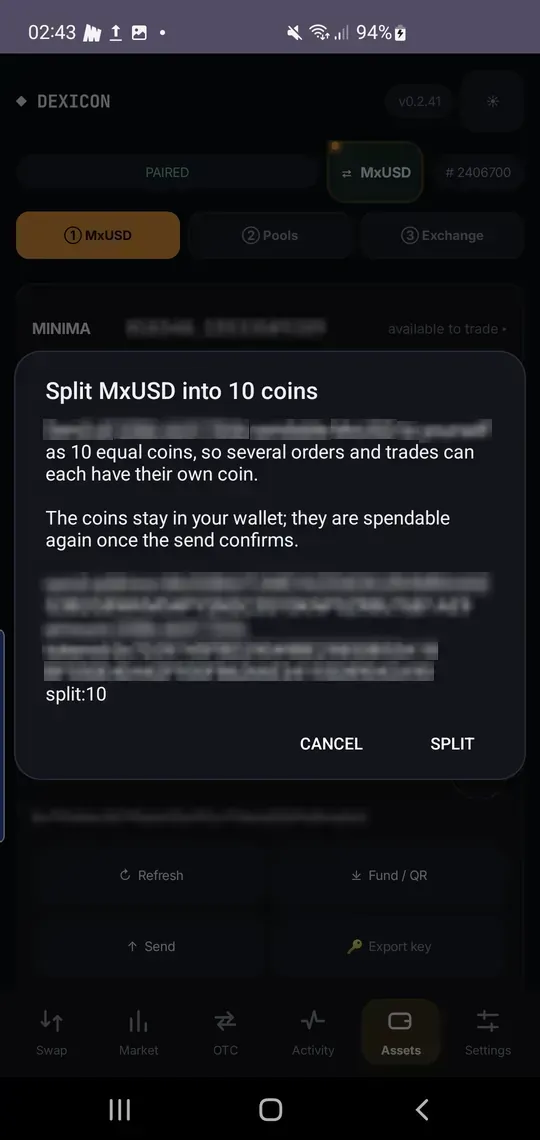
Every guide is real: each screenshot is from the Dexicon client, taken during a live trade on the Minima network. Pick what you want to do.
To use the protocol you need your own Minima node and a Dexicon client. Today's client runs on Android phones and tablets. If you're new, give yourself half an hour, a charged device and Wi-Fi for the first sync.
1. Get a Bear.
A Bear is a Minima node and wallet for an Android phone or tablet. It's your account on the protocol. Android 9 or newer.